
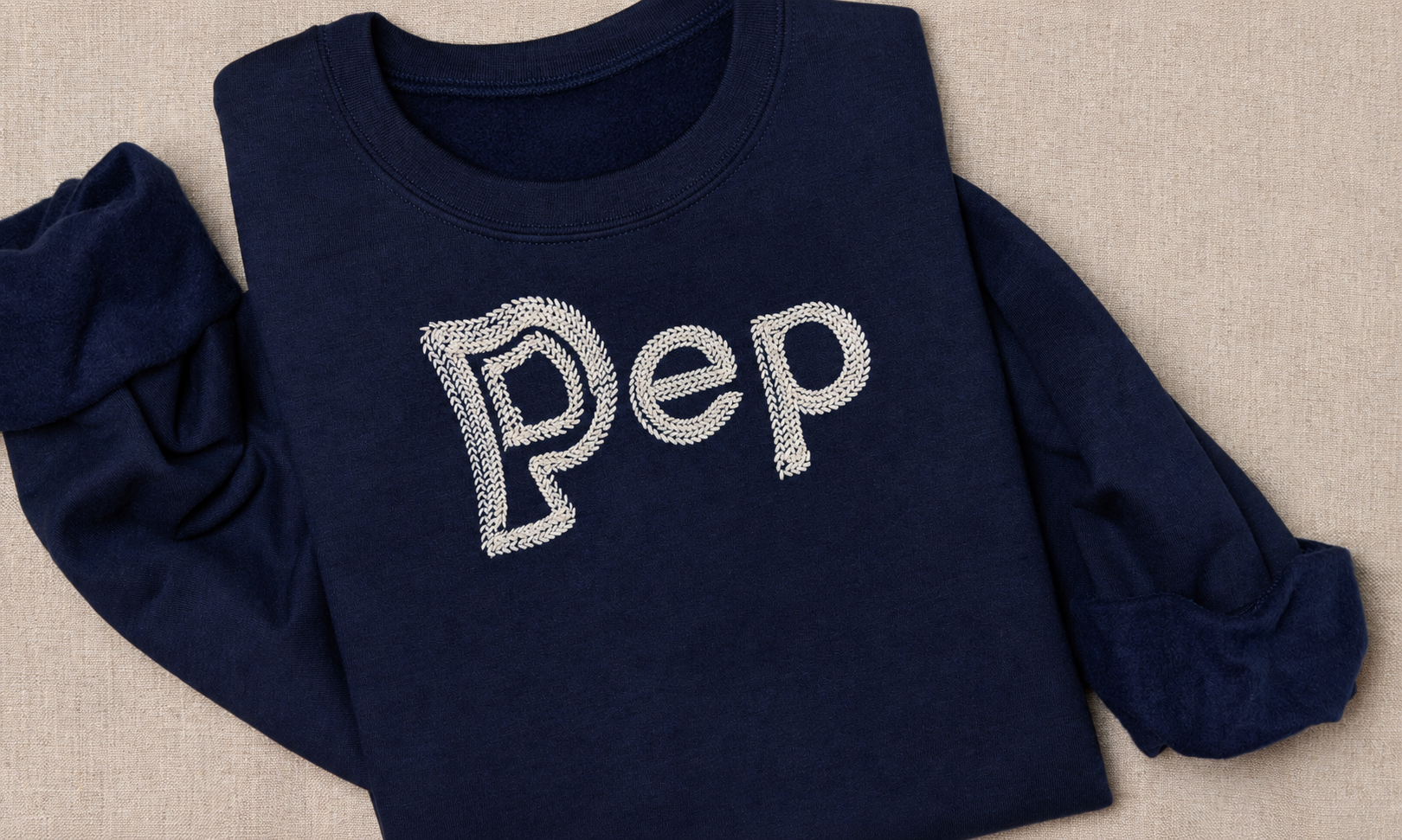
The Art of the Stitch: How Custom Embroidery Elevates Everyday Spiritwear into Premium Essentials
From heritage chain stitching to custom fabric appliqué, explore the specialized embroidery techniques we use to elevate our custom garments into premium essentials. Run your fingers over the threads and discover the artistry behind our collections.
Anyone can slap a logo on a sweatshirt. What separates a piece someone actually wants to wear for years from something that gets tossed in a drawer after one season often comes down to a detail most people never think about: the embroidery.
At The Pep Fund, every collection starts the same way — we design the garment, then work hand-in-hand with our embroiderer to bring it to life. The photos throughout this post are from our own production floor, not stock images. Here's a look at the different techniques we draw from, and why the right one can turn a basic hoodie into something that feels genuinely premium.
Flat Embroidery
Flat embroidery is the workhorse of the embroidery world, and for good reason. It stitches thread directly into the fabric using a combination of satin stitch (for outlines and lettering) and fill stitch (for larger areas), producing a smooth, even surface that reads clean and detailed even at small sizes.
It's the technique behind subtle, tone-on-tone designs — think a small knit-in monogram on a chest, or fine lettering that needs to stay legible without overwhelming the garment. It's also remarkably durable: because the thread is worked into the fabric rather than sitting on top of it, flat embroidery holds up to dozens of washes without cracking or peeling the way a printed graphic eventually will.
3D Puff Embroidery
Puff embroidery uses a layer of foam underneath the stitching, which the machine then stitches over to create a raised, dimensional effect. It's the technique responsible for that bold, slightly bubbled lettering you see on caps, varsity jackets, and streetwear-inspired pieces — the kind of design that catches light and casts its own small shadow.
It's a bolder, more expensive choice than flat embroidery (more material, more machine time), and it doesn't hold up quite as long-term since the foam can compress with repeated washing and drying. But for a single standout graphic — a mascot letter, a bold wordmark — nothing reads louder or more premium at a glance.
Chain Stitch
Chain stitch is one of the oldest embroidery techniques, and it shows in the character of the result: a looping, textured line that looks handcrafted even when it's machine-made. It's the technique that gives varsity jacket lettering and vintage camp logos their distinctive, slightly imperfect charm — you can see the individual loops of thread if you look closely, which is part of the appeal.
It's a beautiful choice for anything leaning nostalgic or heritage-inspired — a script wordmark, a single monogram letter, a camp or team name that's meant to feel like it's been around for decades, even if it was stitched last week.
Chenille
Chenille embroidery is the plush, fuzzy texture most people associate with classic varsity letters — the kind you'd find on an old letterman jacket. It's built up in dense, looping stitches that create real dimension and softness you can feel as much as see. Multicolor chenille, in particular, has a handmade, almost tapestry-like quality that's hard to replicate any other way.
It's a heavier, more textural technique best suited to thicker fabrics that can support it — sweatshirts, jackets, and structured caps — and it instantly signals "this was made to last," not "this was printed this morning."
Appliqué
Appliqué takes a different approach entirely: rather than stitching a design directly into the garment, a separate piece of fabric is cut into the design shape, layered on top of the base garment, and then stitched down — usually finished with a satin stitch border to clean up the edges and lock the fabric in place.
It's an efficient way to cover large areas or bold letterforms with texture and color without an enormous stitch count, which is why it shows up so often on big collegiate letters, camo-lined logos, and oversized graphics on sweatshirts. The layered, dimensional look is unmistakable — you're not just looking at thread, you're looking at fabric on fabric.
Patches
A patch is embroidery's most flexible form: the design is stitched onto a separate backing fabric first, then sewn or heat-applied onto the finished garment afterward. Because the patch is made independently, it can be produced in bulk and applied to almost anything — a hoodie, a hat, a canvas tote — without needing to run every single item through embroidery from scratch.
Patches also carry a built-in sense of history and collectability, the way an old scout badge or a camp patch does. They're an easy way to add a layer of nostalgic, "earned" detail to a piece.
Why It's Worth the Extra Step
None of these techniques are the cheapest or fastest way to put a logo on a shirt. Screen printing will always be quicker and less expensive. But it also can't replicate texture, dimension, or the simple fact that thread worked into fabric feels different in your hands than ink sitting on top of it.
That difference is exactly what separates a garment someone wears once for a school event and a garment someone reaches for years later — the kind with a small knit-in "C," a chain-stitched script, or a chenille letter that still looks and feels great long after the season it was made for has ended. It's a small design decision with an outsized impact on how "worth keeping" something feels the moment you put it on.